by Noah Marion, Political & State Policy Director, WildMontana
This blog was originally published May 21, 2025 by WildMontana. View the blog post on WildMontana here.
A bipartisan bill charts a new course for conservation in Montana, investing millions into parks, trails, wildlife, and working lands.
House Bill 932 reshapes how Montana invests marijuana revenue in our great outdoors. It ensures millions of dollars will continue to support our freedom to hike, camp, hunt, fish. It protects wildlife. And it strengthens our working lands and rural communities.
It’s a first-of-its-kind bipartisan bill that supports everything we love about Montana, and we’re thrilled to have helped make it a reality in 2025.
But how does it work?
The short version: HB 932 will invest around $32 million in recreational marijuana tax revenue into Montana State Parks, trails, working lands, public access, and wildlife habitat over the next two years. That’s a massive chunk of change that can be used to maintain boat ramps, bathrooms, trailhead facilities; support weed and wildfire management on private and public lands; reduce traffic accidents by building wildlife crossings; and even acquire new public lands, so we can all keep enjoying Montana’s public lands while the state grows and changes.
Think that all sounds great? So do we. Go tell your friends!
If you really want to get under the hood of HB 932 and learn how this money will be split up, keep reading.
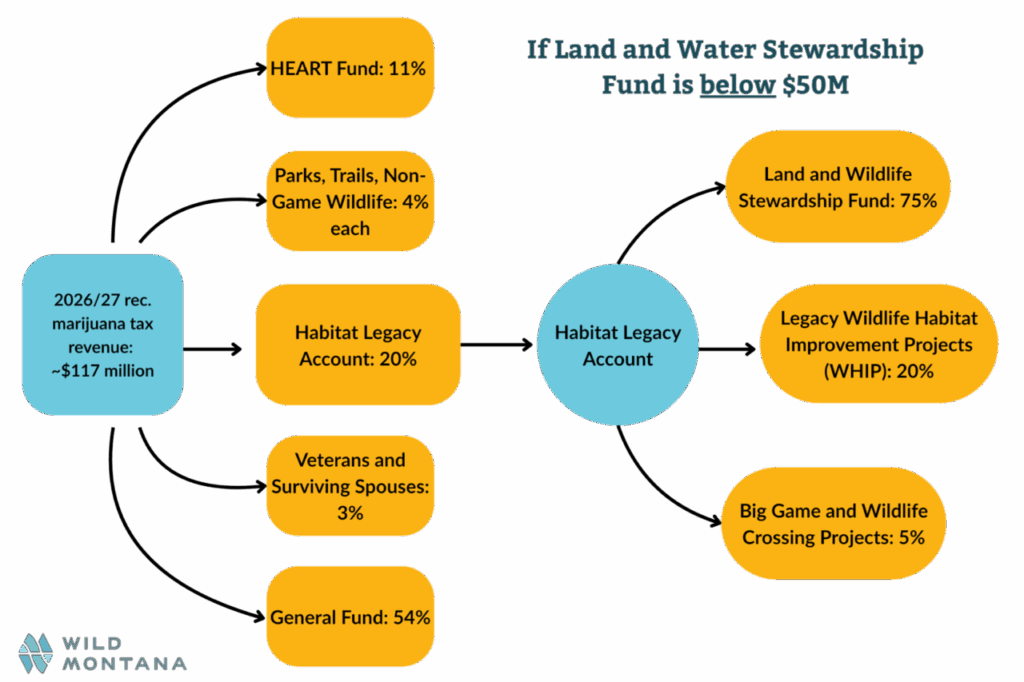
It all starts when the state collects recreational marijuana tax revenue. Montana charges a 20% tax on recreational marijuana sales, which is predicted to add up to about $117 million in the 2027 biennium (the two-year period from 2026-27).
Here’s how that money will be distributed:
- 54% of it, about $63 million, will go to the state’s General Fund, which can be used to pay for programs the legislature prioritizes every two years like education, healthcare, infrastructure.
- 11% will go to the HEART fund, which supports substance abuse treatment and recovery programs.
- 3%, about $3.5 million, will go to a program that helps veterans and the surviving spouses of military service members pay their mortgages.
The rest of the revenue (32%, or about $37 million) will be invested in public lands, access, habitat, working lands, and land stewardship programs.
- 4% will go to each of Montana State Parks, the Montana Trail Stewardship Grant Program, and non-game wildlife conservation.
- The remaining 20% will be directed to the Habitat Legacy Account, a new fund created by HB 932.
The Habitat Legacy Account will work in concert with Habitat Montana, making our state’s conservation and access program even stronger, while increasing their impact, the breadth of projects, and adding much needed flexibility to better get the money on the ground doing good conservation projects.
Once money is deposited into the Habitat Legacy Account, it’s allocated like this:
- 75% goes to the Land and Wildlife Stewardship Account, which protects habitat, funds public access projects, and supports water conservation
- 20% goes to support Wildlife Habitat Improvement Projects (WHIP), which restore habitat, manage noxious weeds, improve working lands, and enhance wildlife connectivity between public and private lands.
- 5% goes to the Wildlife Crossings Account, which helps protect wildlife and improve public safety by funding over- and underpasses and wildlife-friendly fencing projects to support migration.
If the Land and Water Stewardship Fund’s balance is below $50 million:
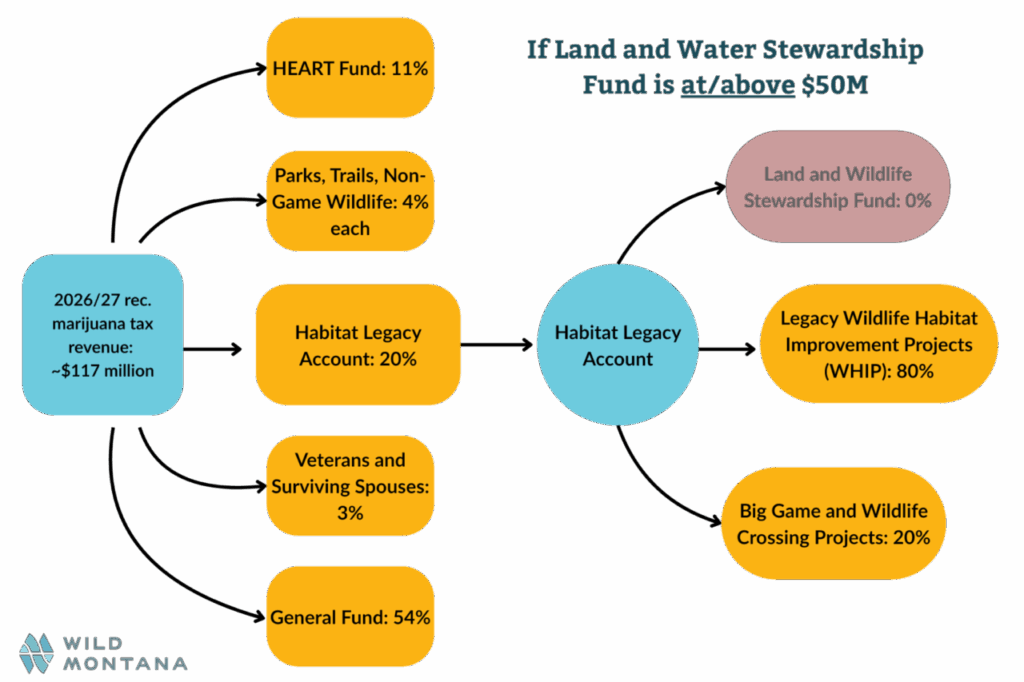
All sounds great! More money for access and conservation benefits all of us, and recreational marijuana is an exciting new source of revenue that we can use to invest in our outdoors. But wait, there’s more. If the Habitat Legacy Account’s (the three bullets listed directly above) balance reaches $50 million, then the Land and Wildlife Stewardship Fund doesn’t receive any more money until its balance is spent down below $50 million. Instead, 80% of the Habitat Legacy Account funding goes to the WHIP program and 20% to wildlife crossing initiatives.
If the Land and Water Stewardship Fund’s balance is at or above $50 million:
Is your head spinning yet? Good, mine is too. The funding flows HB 932 establishes are complex, but they’re thoughtful and intentional. It’s a bipartisan effort that helps people in all walks of life and every part of the state, and it’s a model for how we can keep advancing common-sense conservation initiatives in polarized times. We’d like to thank the three lawmakers who played the biggest role in getting this bill over the line for their foresight and commitment to working across the aisle to pass legislation that’s good for Montana, plain and simple: Rep. Ken Walsh, Sen. Denley Loge, and Rep. Becky Edwards.
And of course, thanks to all the Wild Montana members and supporters who spoke up on behalf of HB 932. Hundreds of you contacted your legislators, testified in committee hearings, posted on social media, wrote letters to the editor, and told your friends and neighbors about why this bill mattered. Your voice makes a difference – this bill is proof.
The state legislature was a success for public lands, but there’s still lots of work ahead. Federal lawmakers are pushing to sell off public lands to corporations, roll back bedrock environmental laws, dismantle land management agencies, and cut the public out of decisions that impact their backyards. We’re fighting back and need your support.
Can you invest in the future of public lands? Give now to support the work ahead.
Thanks, as always, for helping us keep it wild.
 EN
EN  SP
SP