
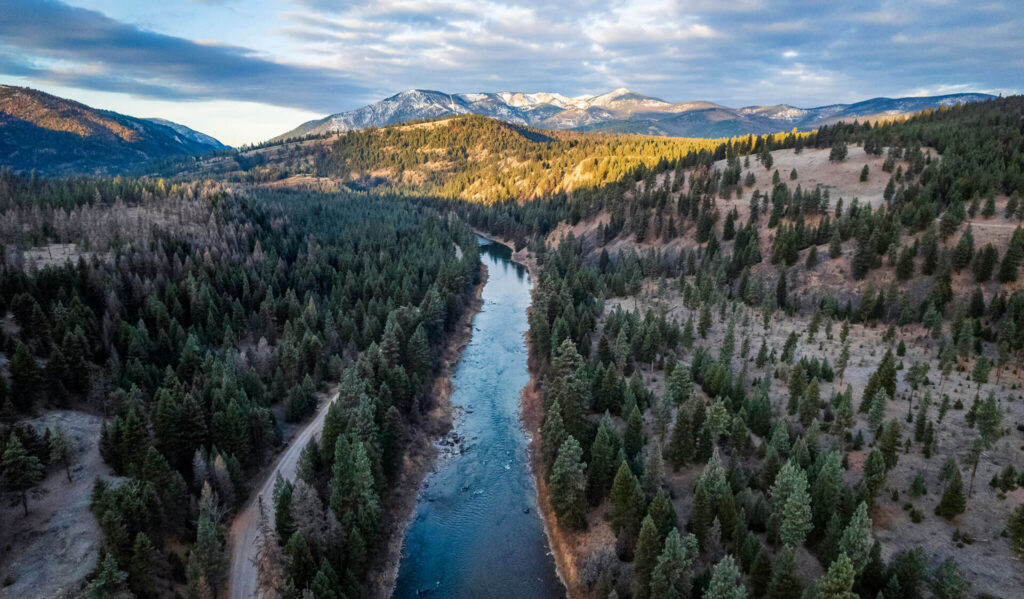
Blackfoot River (photo by Chris Sawicki)
by Zach Angstead, Wild Montana
This blog was originally published June 3, 2026 by Wild Montana. View the blog post on Wild Montana here.
After decades of collaboration, the Blackfoot Clearwater Stewardship Project and Lincoln Prosperity Proposal have united around a shared vision for the Blackfoot Valley
It’s cold outside, but the sky is bright blue as partners from the Blackfoot Clearwater Stewardship Project and the Lincoln Prosperity Group gather for an official meeting for the first time. The setting feels right: Trixi’s Antler Saloon, an iconic Blackfoot Valley gathering place.
Many of the folks in the room already know each other, maybe from a community meeting, a Poker Run, a music festival, or an inter-valley football rivalry. But today, they’re here for something different.
Folks with all different backgrounds are gathered around the table for the love of the Blackfoot Valley. There are outfitters, guides, hunters, anglers, dirt bikers, snowmobilers, trail runners, hikers, bird watchers, firefighters, community leaders, semi-retired foresters, and a fully retired former district ranger.
The discussion begins casually, but the purpose is meaningful: to create something truly special, a vision that supports local economies, stewards the valley’s public lands, and protects some of Montana’s most remarkable wild country.
This initial meeting comes after both collaboratives, the Blackfoot Clearwater Stewardship Project and the Lincoln Prosperity Proposal, have worked for decades on their respective plans. But there’s a dark cloud in the otherwise-blue sky: both groups are worried that their proposals may never become law.
This first meeting isn’t about merging proposals. Not yet.
Instead, it’s an opportunity to understand one another’s work, identify shared values, and explore what might be possible. There’s mutual admiration for the years of effort each group had invested. There are conversations about maps, landscapes, and communities. There are ideas for how to better capture all the work that has already been done, and a commitment to keep talking.
Everyone leaves with homework.
The Blackfoot Clearwater Stewardship Project members spend the next eight months going over maps, talking to neighbors, sharing coffee (or beer), and discussing how to make their proposal reflect all the work that has already gone into it. There are conversations with each other and with foresters, biologists, other recreationists, Forest Service staff, and folks who missed the first go-around.
The members of the Lincoln Prosperity Group talk with their neighbors, elected and community leaders, and offer help where they can to the BCSP group. They work with communities that were overlooked initially and, in the end, tweak their proposal to make it stronger and more reflective of the needs on the ground.
By the end of that period, the Blackfoot Clearwater Stewardship Project has incorporated innovative management approaches pioneered by the Lincoln Prosperity Group. The group has identified new forest restoration areas and strengthened recreation opportunities for motorized users and mountain bikers. It has adjusted boundaries, proposed new designations, and addressed longstanding questions about wilderness study areas.
Upstream on the Blackfoot, the Lincoln Prosperity Group has refined its own boundaries and added a new forest restoration area to its proposal.
Viewed on a single map, something larger begins to emerge: a unified, landscape-scale vision for the Blackfoot and Clearwater valleys.
From ridgetop to ridgetop, the combined proposal is built on a balanced approach that protects clean water in one of the world’s premier trout fisheries, supports local jobs and stewardship work, safeguards wildlife habitat and migration corridors, and ensures future generations can continue to enjoy the valley’s public lands.
Partners often describe the proposal as a three-legged stool of restoration, recreation, and conservation. Each leg depends on the others. Remove one and the whole thing becomes unstable.
The combined proposals will designate 181,000 acres across six different forest restoration areas. The goal of these areas is to maintain and restore forests to ensure that they’re resilient to wildfire, enhance and restore habitat for wildlife and fish, and provide economic stability and healthy places to live for surrounding communities. The groups identified these areas using data from the Montana Forest Action Plan, which identified areas where disease and insects have negatively impacted forest health and where the risk of large wildfires would threaten private property and infrastructure.
Another vital part of ensuring economic prosperity for the Blackfoot watershed is securing sustainable, sensible places for recreation. The proposal will make sure snowmobile and motorized recreation riders don’t lose access to their favorite trails, create loop opportunities, and enhance mountain bike recreation. By working together with partners, the partners secured assurance that recreation can continue supporting prosperity in the Blackfoot Valley while maintaining the area’s unique wild character.
Finally, the proposal will designate 135,000 acres of new wilderness by adding to the Bob Marshall, Scapegoat, and Mission Mountains Wilderness Areas. It will also designate the Nevada Mountain Wilderness, the first standalone Wilderness designated in Montana in over 40 years. But that’s not all – it will also designate 63,000 acres of conservation management areas, a designation pioneered by the Rocky Mountain Front Heritage Act and created to ensure national lands stay the way they are today. For example, if a trail is currently open to mountain bikes, hikers, and horseback riders, that’s the way it will be in the future. If a road is open to the public, it will remain open.
This legislation will protect important habitat for big game, bull trout, and a host of other wildlife. It will ensure access for hikers, cyclists, trail vehicle riders, horsemen, and snowmobilers. And it will help make our communities and our forests more resilient to wildfire.
We’re proud to have worked together for over 25 years to chart a path forward for the Blackfoot and Clearwater valleys and protect the fundamental values that make these public lands, and the communities that rely on them, special. There’s work ahead to help this unified proposal become law, and we’re excited to have your support.

 SP
SP  EN
EN